




CAM Precursors: What They Are and Why They Matter
Feb, 2026
Cathode Active Material (CAM) precursors are the key intermediate compounds used during the production of CAM for lithium ion batteries. These materials help define the chemistry and structure of the final cathode, making consistent preparation essential for downstream battery manufacturing. CAM precursors must be produced under controlled conditions, with careful management of impurities and particulates to support reliable performance. Maintaining clean, stable materials contributes to the quality expected in applications such as electric vehicles, where dependable operation is essential. That is why filtration in CAM manufacturing process is crucial. According to Bloomberg New Energy Finance’s Electric Vehicle Outlook 2020, global EV demand continues to accelerate, increasing the need for high quality battery materials.
What Is a CAM Precursor?
CAM precursors (PCAM) are formulated materials that serve as the basis for producing Cathode Active Material in lithium ion battery applications. Their composition, physical form, and cleanliness influence how the final CAM develops, shaping the performance characteristics required for battery production
A CAM precursor is the engineered intermediate material used to manufacture CAM.
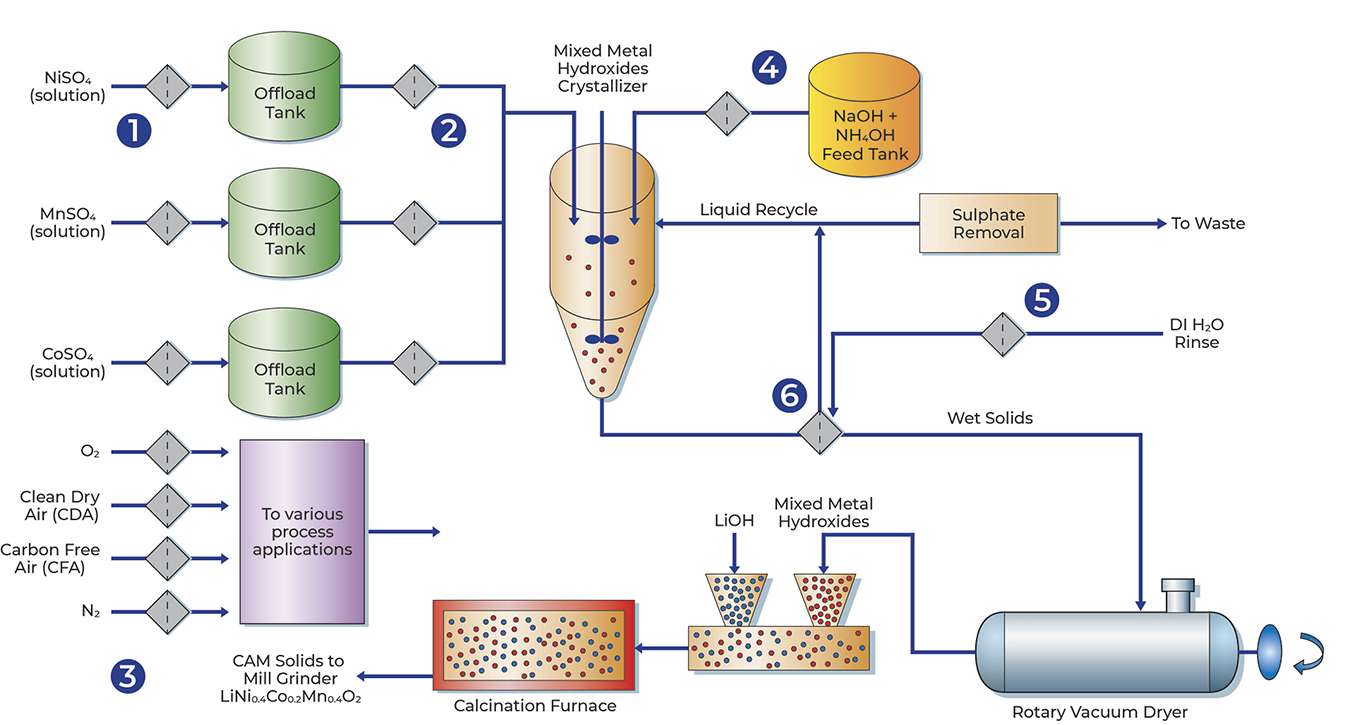
For nickle-cobalt-manganese (NCM) CAM, the precursor consists of mixed metal (Ni–Mn–Co) hydroxides or oxides produced through coprecipitation followed by thermal conversion.
For lithium iron phosphate (LFP) CAM, the precursor is iron phosphate, generated through chemical reaction and purification steps before lithiation and high temperature activation.
These precursor characteristics directly influence CAM consistency, purity, and downstream battery performance, making precursor quality an essential factor in cathode material manufacturing.

How Are CAM Precursors Converted Into CAM?
The conversion of precursor materials into CAM involves multiple processing steps that help establish the final cathode’s structure. These steps typically include preparation, impurity removal, and controlled thermal or chemical treatment to achieve the desired material characteristics. Each stage supports the development of CAM suitable for use in lithium ion batteries.
Why Does Purity Matter in CAM Precursor Production?
Impurities present during precursor preparation can affect how CAM forms and performs in service. Maintaining high purity helps support material consistency, stability, and predictable behavior throughout battery manufacturing. Clean, well prepared precursors play an important role in meeting the quality expectations associated with lithium ion battery applications.
What Needs to Be Removed During Precursor Processing?
As precursors move through processing, unwanted solids, moisture, or trace chemical residues may need to be removed to protect downstream performance. Managing these contaminants supports the production of consistent CAM that aligns with battery manufacturing requirements.
How Does Filtration Support Reliable CAM Precursor Production?
Filtration removes impurities from raw materials and process streams, ensuring CAM precursors meet the strict purity requirements needed for high performance batteries. It stabilizes coprecipitation by preventing fine particle loss and controlling particle size distribution, factors that directly influence precursor consistency and final CAM quality.
Filtration also protects downstream steps by purifying gases such as oxygen, nitrogen, and clean dry air, helping prevent contamination during calcination and material handling. In LFP production, filtration supports clean iron phosphate precursor formation by removing undissolved salts and by products.
Effective filtration contributes to yield improvement, operational cost reduction, enhanced safety, and the reliable production of CAM precursors across both NCM and LFP chemistries. Consistent, high quality filtration helps control particulate levels and remove impurities that could interfere with critical processing steps, supporting the stable precursor quality required for producing CAM materials used in lithium ion battery manufacturing.
Pall Filtration Solutions for CAM Precursor Manufacturers
Pall filtration solutions help CAM precursor manufacturers achieve high purity, consistent particle size control, and reliable process performance by removing contaminants from liquid, slurry, and gas streams throughout NCM and LFP precursor production, supporting the creation of consistent, battery grade CAM.
For more details visit Filtration solutions in manufacturing Cathode Active Material
Frequently Asked Questions
What are CAM precursors?
CAM precursors (PCAM) are the materials used to form Cathode Active Material (CAM) in lithium ion batteries. These precursor compounds help determine the chemistry, structure, and overall performance of the final cathode material.
How are CAM precursors processed into Cathode Active Material (CAM)?
To create CAM, precursor materials are prepared, purified, and then converted through controlled processing steps that support the formation of stable, battery grade cathode material. Each stage influences the quality and consistency required for lithium ion battery production.
Why is purity important when producing CAM precursors?
High purity helps ensure that the final CAM performs reliably inside an EV battery. Impurities can interfere with how the cathode material forms and may affect battery efficiency, stability, or lifespan. Clean, well prepared precursor material supports predictable and high quality results.
What contaminants need to be removed during precursor and CAM processing?
During processing, common contaminants such as unwanted solids, moisture, or residual chemicals should be removed to protect material quality. Removing these impurities helps maintain the stability and performance of the final cathode material.
How does filtration support CAM precursor quality?
Filtration helps remove particles and impurities that may disrupt downstream processing. It supports the production of clean, consistent precursor material, which is essential for meeting the quality standards of CAM used in lithium ion battery manufacturing.
How do CAM precursors impact EV battery performance?
The quality of the precursor directly influences how the final CAM behaves in a battery. Well controlled precursor chemistry helps support strong cycle life, energy efficiency, and overall reliability which are key characteristics expected of EV battery materials.
Subscribe to our blog to stay up-to-date on the latest insights and trends