



Blue Hydrogen
Filtration solutions that support efficiency and operational continuity in natural gas reforming
Blue hydrogen is produced from natural gas reforming combined with carbon capture technologies. Across this process, liquids and particulates can impact equipment, catalyst performance and hydrogen purity. Filtration and separation are applied at multiple stages to manage these contaminants and support consistent operation. Pall provides filtration technologies designed for use throughout blue hydrogen production systems.
What is blue hydrogen?
Blue hydrogen refers to hydrogen produced from natural gas reforming when carbon capture technologies are used to manage associated emissions.
This approach builds on established hydrogen production processes and infrastructure while incorporating carbon capture. Natural gas reforming remains a widely used method for hydrogen production, and when combined with carbon capture, it is commonly described as blue hydrogen.

How is blue hydrogen produced?
Blue hydrogen production follows a sequence of process steps that convert natural gas into hydrogen:
- Natural gas feed preparation
- Reforming to generate synthesis gas
- Shift conversion to increase hydrogen content
- Carbon capture to separate CO2
- Hydrogen purification, commonly using pressure swing adsorption systems
Each stage introduces conditions where contaminants like liquids, particulates or corrosion byproducts may be present. Managing these contaminants is part of maintaining stable operation across the process.
For hydrogen produced using alternative pathways see green hydrogen.
What challenges affect blue hydrogen production?
As natural gas moves through reforming, conversion, and purification, process streams can carry unwanted materials that affect performance.
These challenges include:
- Liquids entering with the feed gas
- Particulates from upstream systems or equipment wear
- Corrosion products within piping and process units
- Soot or fine particles generated during processing
If not managed, these contaminants can contribute to reduced efficiency, operational disruption or impacts on downstream systems.



Why is filtration needed in blue hydrogen production?
Filtration and separation are used to remove these contaminants at critical points in the process.
Key roles include:
- Protecting reformers and heat exchangers from particulate ingress
- Removing entrained liquids to support stable operation
- Filtering fuel gas to protect burners
- Protecting PSA adsorbent beds from liquids and particulates
- Removing contaminants originating from piping or drying systems to support hydrogen purity
These functions help maintain process continuity across reforming, carbon capture and purification stages.
Where is filtration applied in the blue hydrogen process?
Filtration is integrated across both upstream and downstream stages of production.
Feed purification
Coalescers and particulate filters are used to treat incoming natural gas streams. This helps reduce the presence of liquids and solids before reforming.
Hydrogen processing and purification
Further along the process, filtration is applied to:
- Protect compressors and associated equipment
- Maintain adsorbent bed performance in PSA units
- Support the removal of residual contaminants before final hydrogen output
How does Pall support blue hydrogen operations?
Pall provides filtration and separation technologies used across blue hydrogen production processes.
Solutions include:
- Coalescers for liquid removal
- Particulate filters for solids control
- Filtration technologies suited to reforming, carbon capture, and hydrogen purification stages
These solutions are applied to support consistent operation across complex process environments.
What does a typical blue hydrogen process look like?
The diagram below shows a simplified view of blue hydrogen production and where filtration is applied.
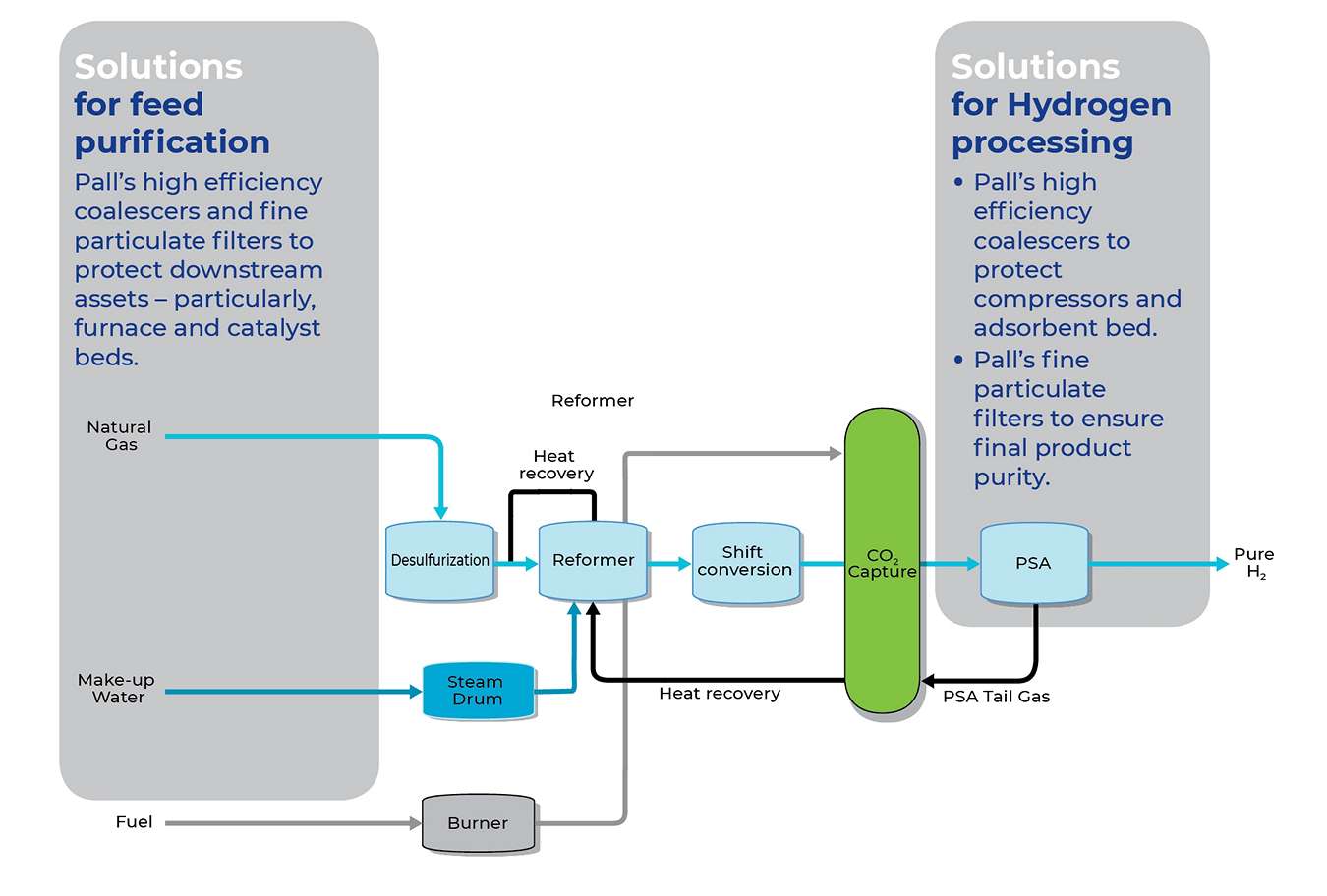
Supporting areas include:
- Feed gas treatment before reforming
- Protection of reformer and heat recovery systems
- Filtration supporting carbon capture stages
- Final purification prior to hydrogen delivery
Frequently Asked Questions
What is blue hydrogen made from?
Blue hydrogen is produced from natural gas using reforming processes combined with carbon capture technologies.
How is blue hydrogen produced step by step?
Production includes feed preparation, reforming, shift conversion, carbon capture and hydrogen purification, typically using PSA systems.
Why are contaminants a concern in hydrogen production?
Liquids, particulates, and corrosion byproducts can affect equipment, catalyst performance and downstream processes if not removed.
Where are filtration systems used in the process?
Filtration is used in feed gas treatment, process protection during reforming and conversion and final hydrogen purification stages.
What types of contaminants are typically removed?
Common contaminants include liquids, corrosion particles, soot and particulates introduced from process equipment or upstream sources.
To explore related processes and applications connected to blue hydrogen production:
Talk to a filtration specialist