




Blog
How Whisky Producers Can Prevent and Remove Chill Haze
Sept 2026
Whisky consumers expect a product that delivers both exceptional flavor and a consistent appearance. As global demand for premium spirits continues to grow, producers face increasing pressure to maintain quality throughout production, storage and distribution. According to Grand View Research, the global whiskey market is projected to grow from USD 82.1 billion in 2026 to USD 116.0 billion by 2033, reflecting continued demand across both established and emerging markets.
As competition increases, maintaining a high-quality consumer experience becomes increasingly important. Appearance remains a key part of that experience, particularly for whisky, where clarity is often associated with product quality.
One challenge that can affect appearance is chill haze. Although chill haze does not impact product safety or flavor, it can create a cloudy appearance that may not align with consumer expectations for a premium whisky. Understanding how chill haze forms and the filtration technologies available to manage it can help distillers support product consistency while optimizing production performance.
What Is Chill Haze in Whisky?
Spirits such as whisky are very fragile and sensitive liquids. During production and maturation, naturally occurring compounds including fatty acids, proteins and esters remain dissolved within the spirit.
When whisky is chilled or stored at lower temperatures, these compounds can become less soluble and begin to form visible particles. This creates a cloudy appearance commonly known as chill haze.
While chill haze does not affect the safety or taste of whisky, it can alter product appearance and may be perceived by consumers as a quality issue.
Why is chill haze important for whisky producers?
While chill haze does not affect the safety of the spirit, consumers often associate product clarity with product quality. A cloudy appearance can raise concerns about consistency, particularly when bottles are distributed across different markets and storage conditions.
For whisky producers, managing chill haze is about more than maintaining visual clarity. It is also about delivering a consistent product experience and supporting brand quality throughout the product lifecycle.
Producers evaluating options for haze management often consider how filtration technology fits within their broader distilled spirits production process and quality objectives.
What are the challenges of traditional chill filtration?
Traditional chill filtration is widely used throughout the whisky industry to reduce or remove haze-forming compounds prior to bottling. The process typically involves cooling whisky to a low temperature before passing it through a filter system.
While effective, traditional chill filtration can introduce additional process complexity. Dedicated chilling equipment, energy consumption and additional processing stages can increase operating costs and production requirements.
As producers seek opportunities to improve efficiency and productivity, many are evaluating alternative filtration approaches that can help achieve product clarity while simplifying operations.
What does non-chill filtered whisky mean?
Some whisky producers explore alternatives to traditional chill filtration while still aiming to deliver a clear, consistent product. The choice between chill filtration and non-chill filtration depends on production requirements, operational considerations and product goals.
For producers seeking to improve efficiency while maintaining product quality, evaluating different filtration approaches can help identify opportunities to optimize performance throughout the process.
Learn more about chill and non-chill whisky filtration in our on-demand webinar here.
Chill filtration vs non-chill filtration: What's the difference?
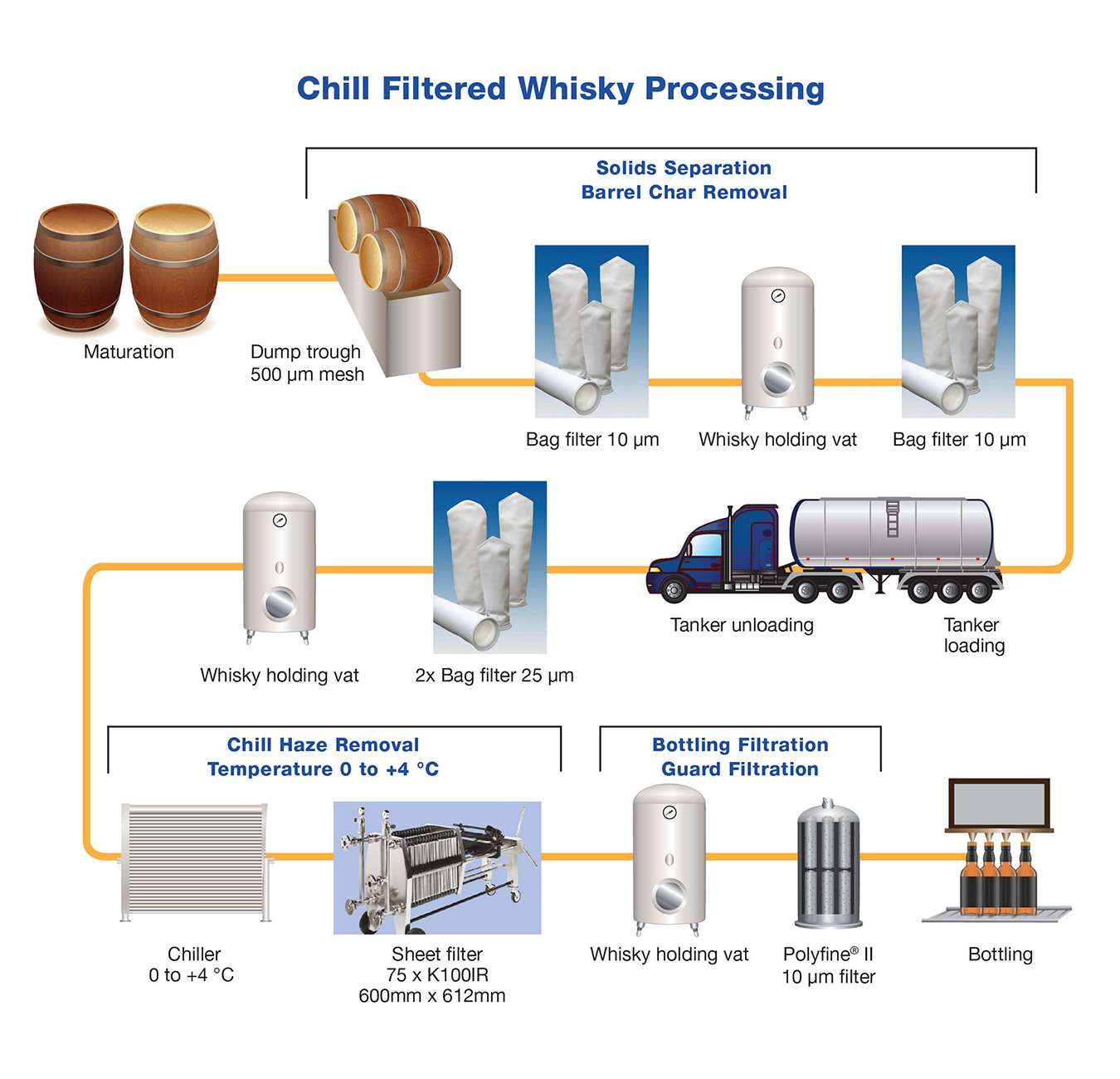
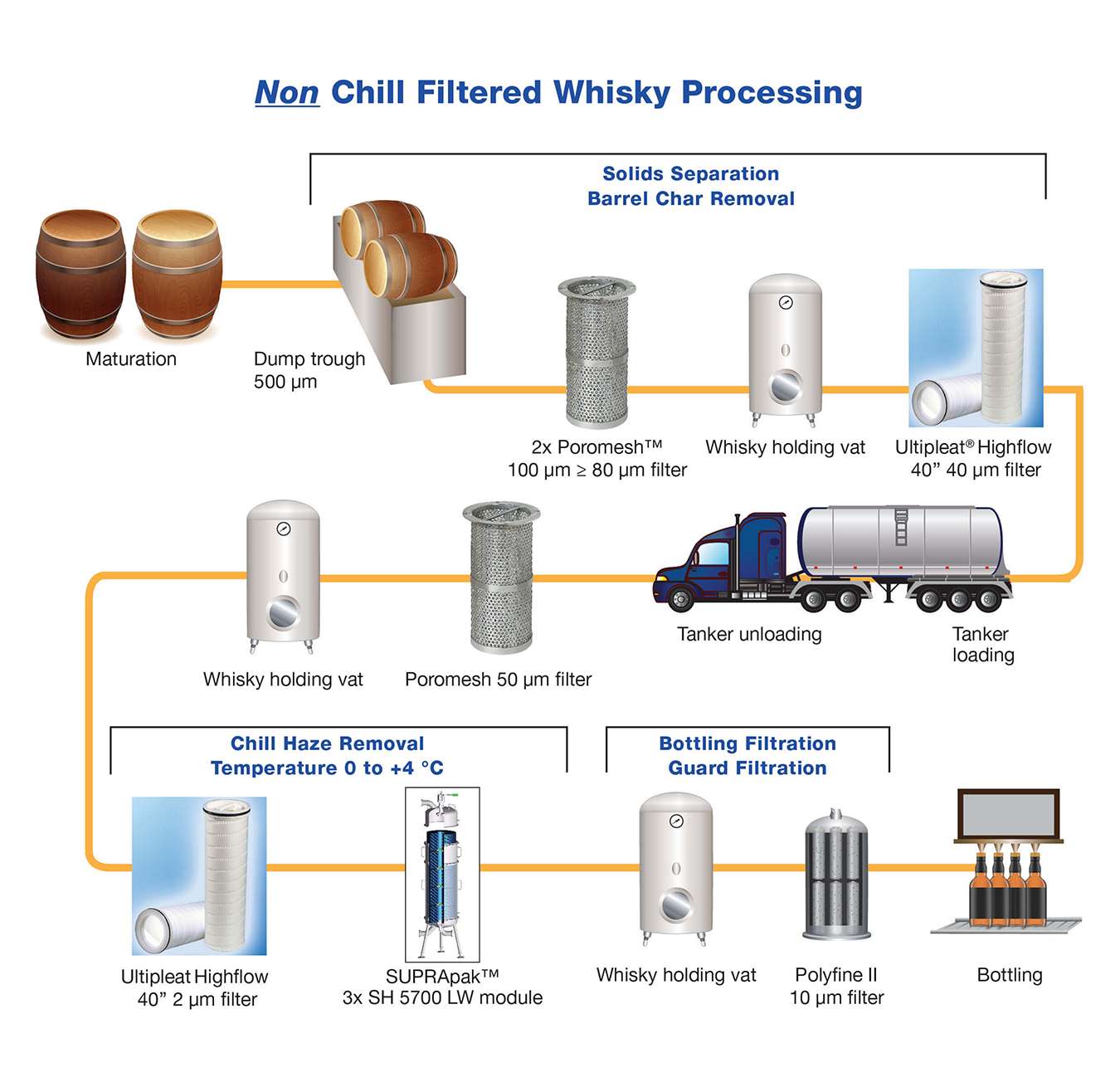
Both approaches are designed to help producers achieve a clear, consistent whisky. The diagrams below compare a traditional chill-filtered process with a non-chill filtration approach, highlighting the key differences in process design and filtration strategy.
Key differences at a glance
- Traditional chill filtration includes a chilling stage before final filtration.
- Non-chill filtration removes the chilling step from the process.
- Fewer process steps can help improve operational efficiency.
- Filtration technology selection depends on product and production objectives.
Process Improvement: Whisky Distillery Case Study
Pall worked with a leading Scottish distillery to address increased turbidity that was affecting process performance. Following analysis of the existing operation, the distillery evaluated a non-chill filtration approach using SUPRApak™ SH modules and Pall's edge flow technology.
The trial demonstrated that chill haze could be effectively managed without a dedicated chilling step, while delivering improvements in production performance and process efficiency.
Key outcomes included:
- Improved turbidity reduction in bottling vat whisky
- Elimination of the chilling process
- Increased production throughput
- Reduced operating costs
- Lower hold-up volume
- Reduced contamination risk
- Improved process availability
Managing chill haze with confidence
Maintaining a clear, consistent whisky requires an understanding of how haze forms and the technologies available to address it. By evaluating existing processes and considering alternative filtration approaches, producers may identify opportunities to improve efficiency while supporting product quality objectives.
Pall works with distillers to help address filtration challenges throughout whisky production. Solutions such as SUPRApak™ modules can help support chill haze management, process performance and product consistency.
To learn more about filtration solutions for distilled spirits and chill haze management, contact our team.
Frequently Asked Questions
Does chill haze affect whisky quality?
Chill haze affects the appearance of whisky but does not affect product safety or flavor.
What causes chill haze in whisky?
Chill haze occurs when certain compounds naturally present in whisky become less soluble at lower temperatures and form visible particles.
What is non-chill filtered whisky?
Non-chill filtered whisky is produced without a traditional chilling step prior to filtration. Producers may evaluate different filtration approaches based on product and operational requirements. The choice depends on factors such as product quality goals, process efficiency and production objectives.
Talk to a Whisky Filtration Specialist
- Category
- Author
- Sort By