



Final membrane filtration is the last filtration step before cider bottling and is used for microbial stabilization in cider prior to packaging. In cider production, earlier clarification, stabilization and pre-filtration remove particles, haze, yeast and bacteria. Final membrane filtration then provides the last step for microbial stabilization before bottling. Pall supports this stage with membrane filters that are laboratory challenge tested for microorganism retention and fully integrity testable in situ. It also offers automated systems for producers who require tighter process control across pre and final filtration. Learn more about cider and perry filtration here.
Cider bottling performance depends on how effectively these stages work together. Final filtration should therefore be considered as part of a connected process, where upstream preparation enables consistent filtration immediately before packaging.
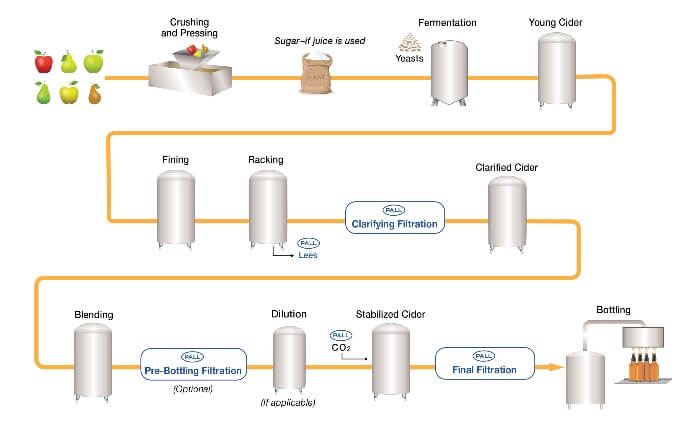
Cider production process showing clarification, filtration and bottling stages
What is final filtration for microbial stabilization in cider?
Final filtration for microbial stabilization is the membrane filtration step carried out immediately before packaging to reduce spoilage organisms remaining after clarification, stabilization and pre-filtration. It functions as a microfiltration process, where cider is passed through a membrane to retain microorganisms while allowing the clarified liquid to pass through. Because it is the final barrier before bottling, it is considered the most critical filtration step in cider production.
Earlier stages reduce particulate and microbial load, but do not replace the need for a validated final membrane filter. The final step ensures that the cider entering the bottle has been processed through a defined and controlled filtration stage aligned with bottling requirements.
Why is final membrane filtration critical before bottling?
As a microfiltration step positioned immediately before bottling, final filtration plays a direct role in maintaining product consistency at the point of packaging. Spoilage organisms present at bottling can contribute to re-fermentation, turbidity and off-flavors after packaging. Because the final filter is positioned immediately before bottling, it plays a direct role in maintaining product consistency and process control at the point of packaging.
Final filtration is particularly important because it addresses risks that remain even after earlier processing stages. These include:
- Residual yeast and bacteria that may lead to refermentation
- Microorganisms that can affect flavour stability
- Contaminants introduced between final processing and bottling
This is why Pall describes final filtration as a critical unit operation in cider production and emphasizes the importance of validated retention and integrity testing at this stage.
Which Pall filters are used for cider final filtration?
Pall supports cider final filtration with both cartridge-based solutions and integrated system approaches, allowing producers to align filtration with their production scale and level of process control.
Supor* Beverage Filter
Supor Beverage filter cartridges are hydrophilic membrane filters designed for reliable retention of spoilage microorganisms during final membrane filtration prior to packaging.
Key characteristics include:
- Available in 0.45 µm and 0.65 µm grades
- Polyethersulfone membrane in a laid-over pleat configuration
- Single open ended configuration for use in sanitary housings
- Suitable for repeated hot water sanitization and in situ steam sterilization
- Fully integrity testable in situ to confirm performance
This combination of membrane design, validation approach and compatibility with sanitization processes supports its use as a final filtration solution in cider bottling.


Imperium™ MSB filter
The Imperium MSB filter is a high area, high flow membrane filter solution designed to support cost efficiency, flexibility and process security in final filtration applications. It can be used alongside standard cartridge configurations within cider bottling processes.
How does the Oenofil system support pre and final filtration?
For mid and large producers, Pall offers the Oenofil system as an automated filtration solution designed for both pre and final filtration prior to bottling. The system combines process filtration experience, automation and cartridge technology to support cold microbiological stabilization alongside a high level of process control.
Successful filtration depends on more than filter selection alone. The Oenofil system integrates key process elements, including:
Controlled filtration flow rate
Selection of appropriate pre-filtration
Use of microorganism-qualified filters
Defined rinsing, cleaning and sanitization procedures
By bringing these elements together, the system supports repeatable filtration performance and consistent preparation of cider prior to bottling.

What should be considered when selecting a cider final filter?
Final filter selection should be based on the full cider bottling process rather than pore size alone. While final filters are often described by pore size, this does not fully define their performance in microbial reduction.
Key considerations include:
Validation against cider-specific microorganisms rather than pore size alone
Integrity testability to confirm performance during operation
The effectiveness of upstream clarification, stabilization and pre-filtration
System hygiene, including rinsing, cleaning and sanitization
These factors determine how successfully cider final filtration performs within the overall bottling process.
Frequently Asked Questions
What is final filtration in cider?
Final filtration is the membrane filtration step carried out immediately before bottling to reduce spoilage microorganisms remaining after earlier processing stages.
Why is final filtration performed before bottling?
It is used to reduce microorganisms that can lead to re-fermentation, turbidity or off-flavors after packaging.
Does pore size define final filtration performance?
No. Pall indicates that pore size alone does not define microorganism reduction. Filters should be validated for bacteria and yeast retention and be integrity testable.
When is an automated filtration system used?
Automated systems such as Oenofil are used by mid and large producers to manage pre and final filtration stages with greater process control.
*Emflon/Supor are trademarks of Cytiva.
Discuss your current cider bottling and filtration setup