



Filter Integrity Testing for Food & Beverage Applications
Verify membrane filter integrity before and after use with integrity testing solutions designed for food and beverage applications. Learn how integrity testing supports product quality, regulatory compliance and microbial retention verification.
Verify Filter Integrity with Confidence
Filter integrity testing is a non-destructive method used to verify that membrane filters remain intact and capable of delivering the required microbial retention. It helps support product quality and regulatory compliance by confirming filter performance before and after use.
Designed for food and beverage applications, Pall's integrity testing solutions help manufacturers confirm that sterilizing-grade and microbial reduction filters are performing to specification without compromising filter structure or performance.
Why Is Filter Integrity Testing Important?
Filter integrity testing plays a critical role in validating membrane filter performance and supporting food and beverage production processes.
It helps support:
- Validation of sterilizing-grade filters
- Consistent product quality
- Regulatory and HACCP compliance
- Reduced contamination risks and costly downtime
Integrity Testing Devices for Food & Beverage Applications
Pall offers a range of integrity test filters and automated testing devices, including the Palltronic® Compact Touch, designed for ease of use, accuracy and compliance.
These systems support:
- Forward flow testing
- Pressure decay testing
- Reliable detection of filter breaches
- Fast, repeatable results for batch release and process validation
The Palltronic® Compact Touch integrity testing device supports integrity testing workflows for food and beverage filtration applications.
Benefits of Pall’s Filter Integrity Testing Solutions
Pall integrity testing solutions are designed to support reliable validation and documentation processes.
- 100% of filters tested during manufacturing
- Compatibility with sterilizing-grade and microbial reduction filters
- Support for both pre-use and post-use testing
- Enhanced traceability and documentation
Which Integrity Tests Are Used for Membrane Filters?
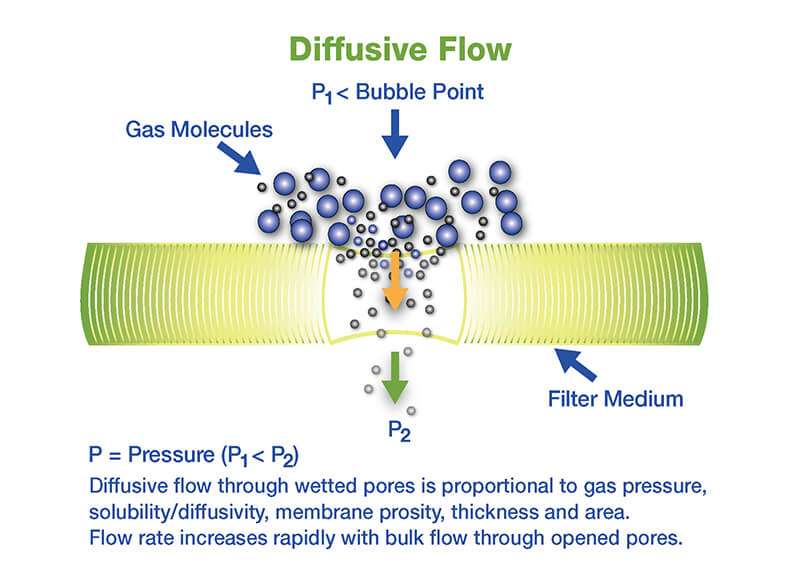
Two integrity tests are recommended to confirm the integrity of microbial reduction and sterilizing-grade membrane filters: Forward Flow and Pressure Decay.
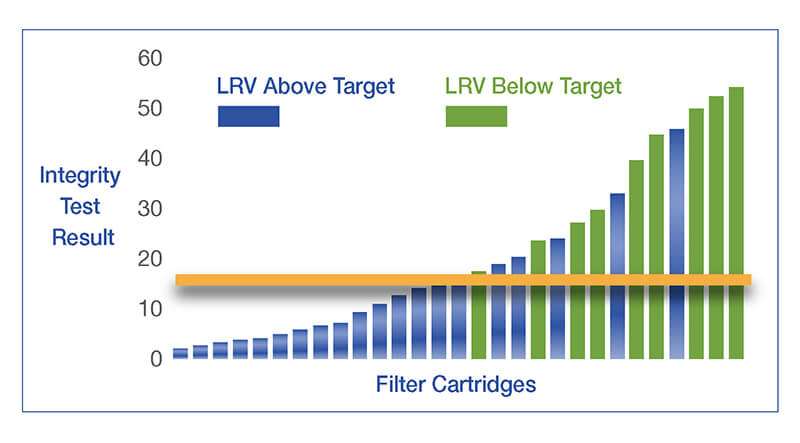
The forward flow value is linked to the results of the bacterial challenge test. The pressure decay value is derived from the forward flow value and the volume upstream of the housing.
These tests correlate to a set microbial removal or reduction level during the initial filter validation. As non-destructive tests, they may be used after sanitization and at the end of a production batch to show the filter assembly is integral. These tests are based on the same principles governing gas flow through a wetted pore.
Integrity test values are linked to validated microbial retention performance.
Water Intrusion Test (WIT)
Water flow is measured through a hydrophobic filter and correlated to microbial retention.
Bacterial retention testing is the most sensitive integrity test for sterilization ability and microbial reduction. Testing for filter integrity can be destructive and may contaminate the filter with test bacteria, making the filter unsuitable for use.
If properly correlated, non-destructive integrity tests can indicate how effectively a filter retains bacterial challenges.
Looking for an Integrity Testing Solution?
Integrity testing helps verify that membrane filters continue to meet required microbial retention performance before and after use.
Contact an Integrity Testing Specialist
Discuss integrity testing, microbial retention validation and integrity testing solutions with a Pall specialist.
What Should You Consider When Performing Integrity Tests?
| Consideration | Guidance |
|---|---|
| Selection of Integrity Test Fluid | Water: Hydrophilic filters (FF/PH/BP), hydrophobic filters (WIT).
Alcohol/Water: 60/40 IPA/Water is common. 25% t-butanol (Pallsol). 100% IPA or ethanol not recommended due to elevated diffusion.
Process Fluids: Product, buffers, pH adjusters and other process fluids (derived values). |
| Pressurization Gas | Acceptable: Air, nitrogen, argon.
Not Recommended: Carbon dioxide (solubility concerns), oxygen (reactivity concerns). |
| Temperature | Maintain temperature within 5°C during testing. The recommended range is 20°C ± 5°C (68°F ± 9°F). Temperature changes can affect gas diffusion and pressure measurements. A 1°C change can cause an approximate 0.3% volume change. |
| Upstream Volume | Important for pressure decay testing. Where filters are effectively regenerated, service life may ultimately be dictated by structural integrity. |
Frequently Asked Questions
What is filter integrity testing?
Filter integrity testing is a non-destructive method used to verify that membrane filters remain intact and capable of delivering the required microbial retention.
Why is filter integrity testing important?
Integrity testing helps support product quality, regulatory compliance, HACCP requirements and contamination control.
What is a forward flow test?
A forward flow test measures the gas flow required to maintain a specified test pressure across a wetted membrane filter.
What is a pressure decay test?
Pressure decay testing measures the drop in pressure across a filter system after stabilization at a defined test pressure.
What is a water intrusion test?
A water intrusion test measures water flow through a hydrophobic filter and correlates the result to microbial retention.
Protect Your Process with Integrity Testing Solutions
Explore Pall’s range of integrity test filters and devices to help ensure filtration systems meet the required standards of product quality, safety and performance.
Contact an Integrity Testing Specialist
Palltronic® Compact Touch
Learn more about the next generation of pressure decay integrity test devices, designed specifically for Food & Beverage producers.